
If something happens to you, who has the legal authority to make decisions on your behalf?
Part 1: Health care Representatives and Advance Directives
Denise Bonk
4/28/20263 min read
The answer may surprise you. if you have not created the proper legal documents, the people you want to make those decisions may have no legal authority to do so.
Imagine you’re hospitalized unexpectedly after an accident or serious illness. You’re unable to communicate, pay your bills, manage your finances, or make medical decisions.
A Health Care Representative (sometimes called a Medical Power of Attorney, Healthcare Surrogate, or Health Care Proxy depending on your state) allows you to name someone to make medical decisions for you if you are unable to make them yourself.
This person may need to:
Speak with doctors
Approve or decline treatment options
Make emergency medical decisions
Carry out your wishes regarding life support or end-of-life care
Depending on your state, a health care representative may be designated on a document called an advance directive. This document can take many forms and be as detailed as you'd like.
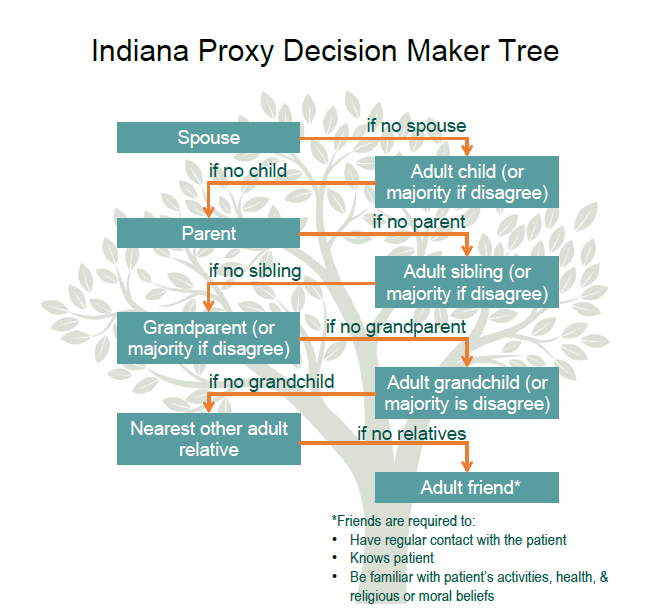
Without formally designating a health care representative, medical providers may be limited in who they can communicate with and who can legally make decisions. In Indiana, and many other states, a hierarchy of authority is provided in the statute if you have not completed paperwork designating a healthcare representative. Below is an illustration of the statutory designation in Indiana.
Maybe you are okay with the State's determination. But you do not want to put anyone in a situation of having to make critical decisions about life-sustaining treatment who was not prepared to take on that responsibility and does not know your health care wishes. Unfortunately, this can happen if you do not have legal documents appointing a health care representative. It is not only important to choose the right person but also to make sure you have a conversation confirming that they are comfortable with this responsibility and are willing to honor your healthcare requests. The role of a health care representative should not be viewed as having to make life or death decisions regarding your health care but as being your voice making sure you are cared for the way that you want.
When trying to decide who would make a good health care representative, you should consider:
Are they responsible?
Are they calm under pressure?
Are they willing to advocate for your wishes?
Are they available when needed?
Once you have decided who you would like to appoint as your healthcare representative, you will then need to document how you would like your health care to look. For example, if a physician has determined that you are terminally ill or in a persistent coma, do you want artificial nutrition or hydration (feeding tube)? If you have no pulse and if you are not breathing, do you want them to attempt resuscitation? Do you want to be an organ donor? This list is not all inclusive and difficult to think about. For many people who have not had to deal with the death of someone close to them, the first time they are asked to think about these things is during the preparation of legal documents. How you think and feel about your care may change over time and you can always change your mind. The important thing is that your health care representative knows how you feel and you keep your advance directive current.
Below are some helpful resources:
Image of Indiana Proxy Decision Maker Tree is courtesy of Indiana Patient Preferences Coalition. This organization promotes education, resources, and advocacy in support of high-quality advance care planning that upholds the personal dignity and values of Indiana residents nearing the end of life. There are many helpful resources and articles on their site: The Indiana Patient Preferences Coalition
The Indiana Department of Health has an Advance Directives Resource Center providing sample documents and references to the law: Health: Consumer Services and Healthcare Regulation: Advance Directives Resource Center
PREPARE is a nonprofit initiative that aims to make advance care planning accessible, offering materials in multiple languages and for all 50 U.S. states: https://prepareforyourcare.org/
As always, I am here to help you with your estate planning preparation in Indiana.
Denise Bonk, Attorney at Law
Phone
317-202-5773 (talk or text available)
PO Box 40233 Indianapolis IN 46240
© 2025. All rights reserved.
The information contained on this website is intended to introduce prospective clients to Denise Bonk, Attorney at Law and is not to be considered a legal opinion or an offer to represent you. This website is not intended to establish an attorney-client relationship. Emails sent to Denise Bonk, Attorney at Law through the use of this website, are not confidential and do not create an attorney-client relationship.